
How to Search Civil Dockets
Michigan gives the public one free entry point: MiCOURT Case Search. It pulls together available Gogebic County civil dockets from participating courts. Begin by picking the court listed on the complaint, notice, or order. That choice keeps a 98th District civil matter from tangling with a 32nd Circuit case or a probate proceeding. Treat what you see as informational. MiCOURT can identify the case. It may show an event sequence and a next hearing. But the clerk's file is what controls when you need a document or the current status confirmed.
Enter the full case number if you have it. The docket ID follows a year-number-type pattern. An original case number can tie a reopened or related matter back to an earlier filing. No number? Search by party name, then narrow by court, filing year, or case type where the public interface allows. A blank result screen proves little. The civil filing may be old, transferred, restricted, filed under a different party role, or simply not exposed by the public interface.
- Identify the Gogebic County court named in the civil paperwork and preserve the complete case number, if shown.
- Open MiCOURT Case Search, choose the court when possible, and search the case number before using a party name.
- Open the matching Gogebic civil docket and record the court, case type, filing date, status, disposition, and next hearing.
- Read the event history for filings, service, motions, orders, or a judgment without treating a single entry as the whole court file.
- Contact the clerk for a particular document, an inspection question, or a certified copy of a public civil record.
Gogebic Civil Docket Court Split
Civil records in Gogebic County do not sit in one big docket. The 98th District Court takes civil cases under $25,000. It also takes small claims, landlord-tenant matters, and related district civil cases. The 32nd Circuit Court takes general civil lawsuits over $25,000. It handles other circuit-level civil work too. Probate holds its own ground. It covers estates, guardianships, conservatorships, trusts, wills for safekeeping, and protective matters. A dispute that sounds civil may truly belong in Probate, not on the district or circuit civil docket.
| Gogebic court | Civil docket context | Search and records route |
|---|---|---|
| 98th District Court | Civil matters under $25,000, small claims, landlord-tenant, and related district cases | MiCOURT case history and the district clerk for the court file |
| 32nd Circuit Court | General civil lawsuits over $25,000 and other circuit-level civil matters | MiCOURT case history and the circuit clerk for the court file |
| Gogebic Probate Court | Estates, trusts, guardianships, conservatorships, and protective matters | MiCOURT where public and the Probate Register for record questions |
The Gogebic Probate Court contact and forms page lists the court's forms and contact details for that separate probate route.
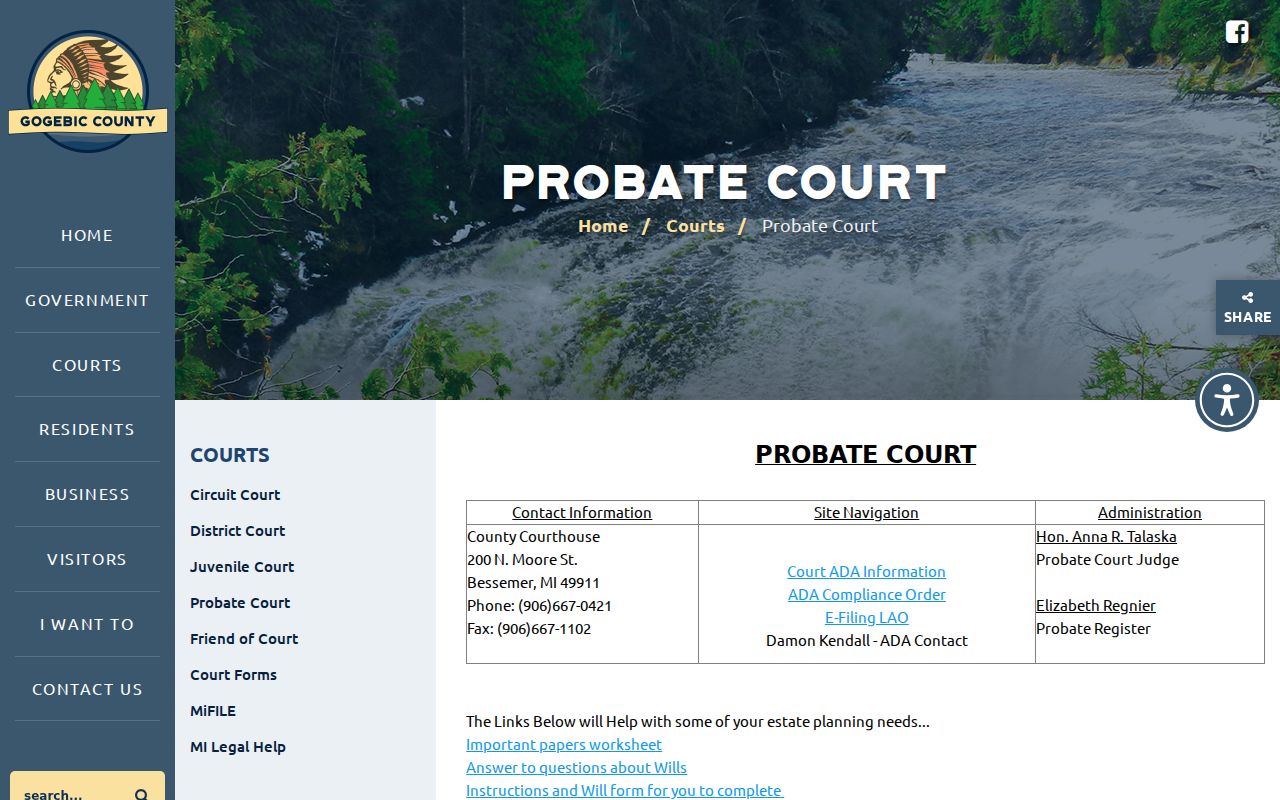
Because probate has its own contact path, a Gogebic civil docket search works best when it starts from case type and court name. Not every civil-looking dispute is an ordinary circuit or district case.
What a Civil Docket Shows
A Gogebic civil docket reads like a timeline. Depending on the court and case type, the public result can list a case number, original case number, filing or reopen date, parties, case status, disposition or closing date, judge, next hearing, and event history. Case status is just an administrative label. Think open or closed. The label alone never states the legal result. A disposition names a recorded resolution category, while the signed order or judgment supplies the detail when the exact outcome matters.
| Case number | The complete identifier for the Gogebic civil matter. Preserve the full year-number-type pattern rather than a shortened label. |
|---|---|
| Parties | The people or entities in the action and their roles. A party listing alone does not explain the claim or outcome. |
| Filing and service | Entries such as complaint, summons, answer, notice, or proof of service. A filing or service entry is procedural, not a judgment. |
| Motions and orders | A motion asks the court to act. An order records a judicial direction or ruling, subject to later amendment or superseding action. |
| Judgment and closure | A judgment is the operative result. A closed status can still be followed by an appeal, enforcement, satisfaction, or record request. |
MiCOURT may split its display into separate views for event history, financial-order categories, parties, next hearings, and other resources. An empty group does not mean the clerk's file is empty. Need a specific pleading, exhibit, order, or satisfaction certificate? Ask for that item by title and date.
Gogebic Civil Docket Terms
Read the event label, not just the case title. The common civil terms below mark distinct steps in a Gogebic court file. A label tells you the type of entry. It does not always state the final effect.
- Complaint
- The pleading that starts a civil action. It states a claim, not a court finding that the claim is true.
- Proof of service
- A record that a document was served or that an attempt was documented. It is different from a judgment or an appearance.
- Motion
- A request for court action. Its filing does not show that the judge granted it.
- Stipulation
- An agreement submitted by the parties. It can require court approval before it becomes an enforceable order.
- Default
- A procedural result after a party fails to respond or appear, subject to the governing court rules and later motions.
- Garnishment or satisfaction
- Post-judgment collection or a record that a judgment was satisfied or released. Verify the underlying certificate or order for the precise effect.
A settlement entry, a dismissal, and a judgment are three different things. The same goes for an adjourned or continued setting. That just means a date moved; the dispute itself did not end. Read the later order and the disposition field together. That is the safest way to describe the current status of a Gogebic civil case.
Types of Civil Cases on the Docket
Case type points you to the right Gogebic court. The district court handles civil claims within its monetary limit. It also takes small claims and landlord-tenant matters. Circuit civil dockets carry the broader litigation above that limit. Probate and family-related proceedings follow their own jurisdiction and access rules. That holds even for property, support, custody, or an estate. What the public can search varies by court and record type.
- District civil claims under $25,000.
- Small-claims filings and their related service, default, satisfaction, or appeal activity.
- Landlord-tenant summary proceedings, which can show possession, rent, service, settlement, default, and judgment events.
- General civil lawsuits over $25,000 in the 32nd Circuit Court.
- Probate proceedings involving estates, trusts, guardianships, conservatorships, or protective matters.
Some family, juvenile, adoption, name-change, protective-order, and mental-health records carry special confidentiality rules or stay out of the general public search entirely. A public category label never makes every document in the file open to inspection.
Gogebic Small Claims Dockets
Small claims lives in district court. The Michigan small-claims packet covers the whole life of a case: the affidavit and claim, service and removal papers, motions to set aside a default, subpoenas, installment forms, a satisfaction certificate, seizure-order material, and appeal forms. Seeing one of these titles tells you a step exists. It does not tell you the claim was won, lost, paid, or appealed.
The filing counts are court workload, nothing more. In 2021 the 98th District Court reported 145 new civil cases. It also reported 20 new small-claims cases. It logged 33 new summary proceedings as well. Those categories sit inside one court's reporting unit. Do not blend them with the 32nd Circuit's 2023 report, which covered Gogebic and Ontonagon together and listed 38 civil filings; the courts, the years, and the reporting definitions all differ. No figure here totals every civil matter in Gogebic County.
Case form versus docket result: A small-claims affidavit, subpoena, or satisfaction form marks a filing or process step. The docket entry and later order show what the court did with it.
Settings and Hearings on Civil Dockets
Hearing dates for a Gogebic civil case come from the court where the case sits. MiCOURT case history may list a next hearing. The public MiCOURT Court Display works differently. It is a calendar built around a specific date. For public events it may list Party Name, Time, Room, and Case Number. Treat it as a day's view, not the full civil docket. A case can be public yet show nothing for the date you picked. Protected matters stay off the public display entirely.
Read the court field first. The 98th District, 32nd Circuit, and Probate Courts are separate courts. Their offices share the Bessemer courthouse address. So a room or time means little without knowing which court set it. When a date is continued or adjourned, the setting simply moved. On the local MiCOURT entries, REVIEW means no in-person hearing is scheduled. The Gogebic court pages say so. If a civil setting seems unclear or changed, call the court before you appear. The Gogebic County court calendar walks through the full calendar process.
Gogebic Civil Docket Filing
Gogebic County's MiFILE information covers electronic filing for 98th District civil cases. It also covers Gogebic Probate Court matters that take part in the e-file workflow. Who has to file this way? The county says attorneys and local self-represented litigants must e-file in participating workflows, under MCR 1.109(G)(3)(f). A MiFILE account is free. You need one to file. Note the limit: MiFILE is not a public document archive. A filing login is not a case-search account. Check your case type before you count on e-filing for a particular civil docket matter.
The official MiFILE Available Courts list shows the participants. Gogebic 98-1 District Court and Gogebic Probate Court are on it.
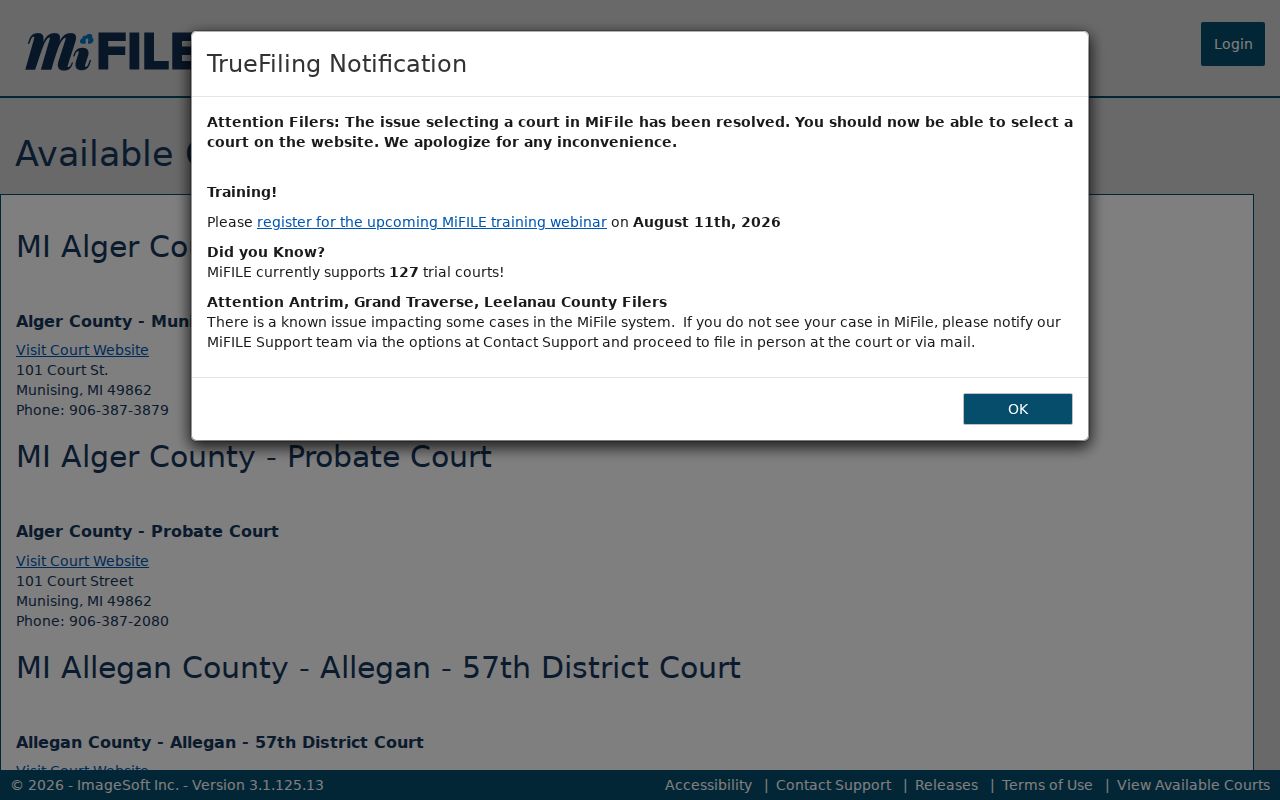
Those entries describe a filing route, nothing more. They do not mean every Gogebic civil document, older paper file, court event, or public record can be browsed through MiFILE.
Public Access to Civil Dockets
Public case history helps you find a Gogebic docket, but access has limits. One public case can still hold a sealed exhibit. It may also carry a protected personal identifier, confidential financial material, or a restricted attachment. Probate, family, juvenile, adoption, mental-health, and protective matters carry extra restrictions. A search can return nothing for several reasons. The cause may be an access rule, a record type, the wrong court selection, or a historical migration issue. It is not proof that a filing never happened.
Michigan Court Rule 8.119 supplies the framework for any available public court record. Ask the clerk about inspection, reproduction, certification, mailing, redaction, or availability. Gogebic's pages post no general plain-copy or certified-copy fee table. Request the current cost directly. Confirm the document is public before ordering. County FOIA covers county-government records only. It does not replace the clerk's process for a judicial civil file.
Key Rules:
Michigan Court Rule 8.119 governs maintenance, inspection, copying, and access to Michigan trial-court case records.
MCL 15.234 addresses public-body FOIA fees, which should not be automatically applied to a court inspection request.
MCL 15.235 sets the FOIA response framework for public bodies and does not displace the judicial-record process.
Gogebic Civil Docket Files
What you see online is the docket, not the whole file. Behind a docket can sit many papers. A Gogebic civil case file may hold a complaint, answer, motion, brief, exhibit, service proof, stipulation, judgment, garnishment, satisfaction, or appeal paper. Some of those documents never appear online. The strongest request names the court first. It adds the full case number, the document title, and the entry date, then asks for inspection or a plain or certified copy as appropriate. A specific request like that beats a blanket ask for every record tied to a name.
Older records can run thin online. The clerk stays the authority on retention, location, and what the public can get. Before traveling, contact the court. Ask whether the file is electronic or paper, whether the document can be pulled, and whether a redacted copy exists. For a wider document-request workflow, see Gogebic County court records.
Note: A civil docket entry can name an order or judgment. When exact language or certification matters, request the signed item from the clerk.